

Increasing a slot bet can make the amount won or lost on each spin much larger. It does not usually make the reels more generous.
If a slot uses the same paytable, reel structure and feature rules at every standard stake, moving from the minimum bet to the maximum bet does not change its theoretical Return to Player. The Random Number Generator still selects outcomes according to the same underlying game mathematics. A 20x result pays more money at a larger stake, but it is not automatically more likely to appear.
There are important exceptions. Some games change the number of active paylines, unlock a jackpot only at an eligible stake, add an Ante Bet or Super Spin mode, or treat a Bonus Buy as a separate wager. In those cases, the rules or effective RTP may change because the player has changed the game mode—not simply because the cash amount is higher.
The safest short answer is:
A larger standard bet usually increases financial exposure, not the RTP. Check the paytable whenever the wager activates additional lines, jackpots or paid features.
TABLE OF CONTENTS
What Slot RTP Actually Measures
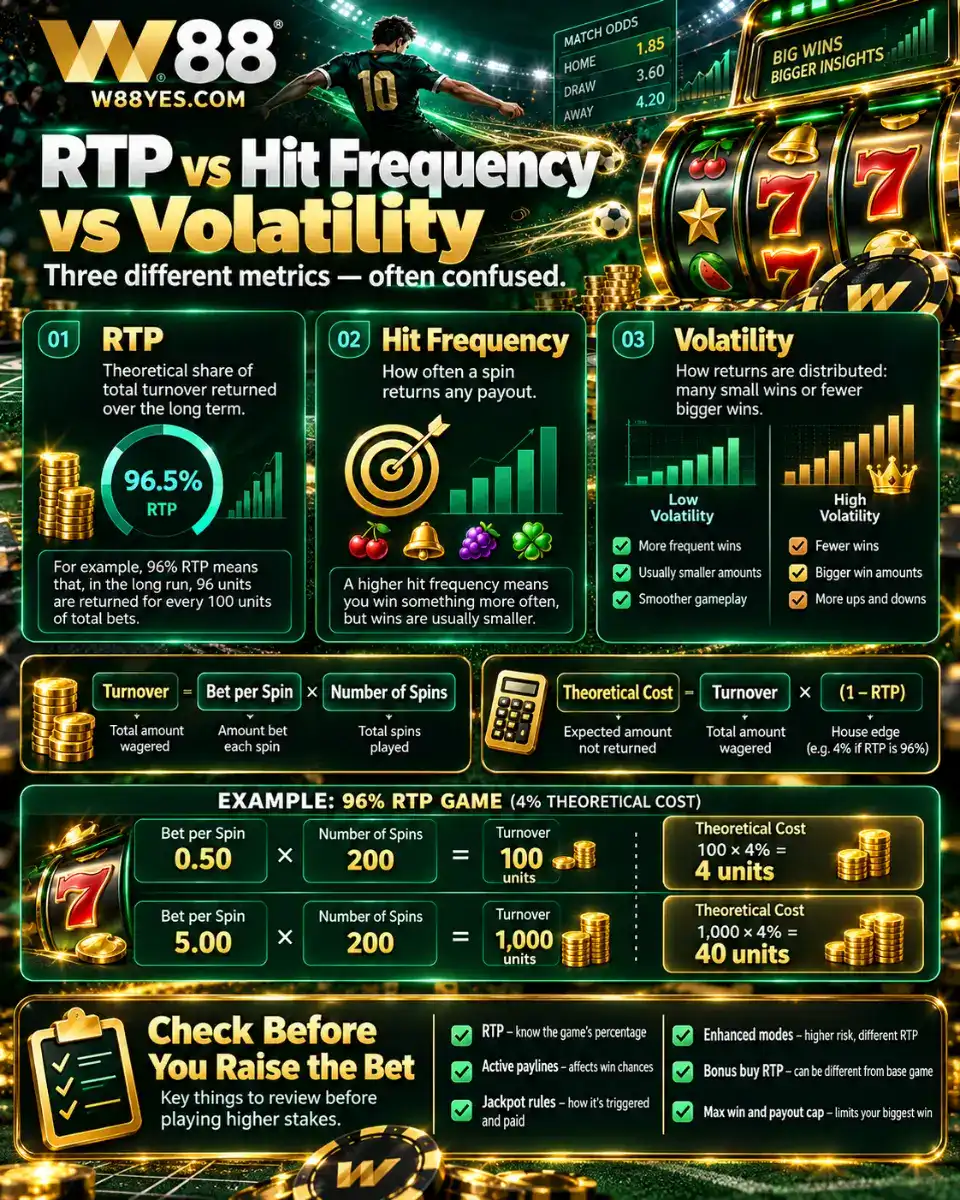
Return to Player, normally shortened to RTP, is the theoretical percentage of total wagered money that a game is designed to return as prizes over a very large number of rounds.
For example, a slot with a theoretical RTP of 96% is designed to return an average of 96 units for every 100 units wagered across its long-term mathematical cycle. The remaining 4 units represent the theoretical house advantage.
This does not mean every player receives 96% of their money back. It also does not mean a session containing 100 spins should finish close to 96% RTP. A short session can end with a large win, a complete loss or anything between those outcomes because actual results fluctuate around the long-term model.
The basic relationship is:
Theoretical RTP = Total Prizes Returned ÷ Total Amount Wagered × 100RTP is therefore a percentage calculated from turnover. It is not a promise for one player, one deposit or one session.
Does Changing the Stake Change the RNG?
On a standard online slot, the Random Number Generator selects the result of each valid spin. Properly tested random outcomes must be unpredictable and statistically independent. The previous spin does not make the next spin “due” to win, and increasing the bet does not normally instruct the game to create a better result.
Imagine a slot that offers wagers from 0.20 to 5.00 units while keeping the same reels, paytable and features active. If the game rules do not say that the wager changes anything else, the probability of landing a particular symbol combination remains the same at 0.20, 1.00 or 5.00 units.
What changes is the value attached to that result.
- A 10x result at a 0.20-unit stake returns 2.00 units.
- A 10x result at a 1.00-unit stake returns 10.00 units.
- A 10x result at a 5.00-unit stake returns 50.00 units.
The multiplier is identical. The monetary result is different because it is multiplied by a different stake.
Minimum Bet vs Maximum Bet
The minimum bet is the smallest valid total wager accepted for one spin. The maximum bet is the highest total wager permitted by the game or operator for that spin.
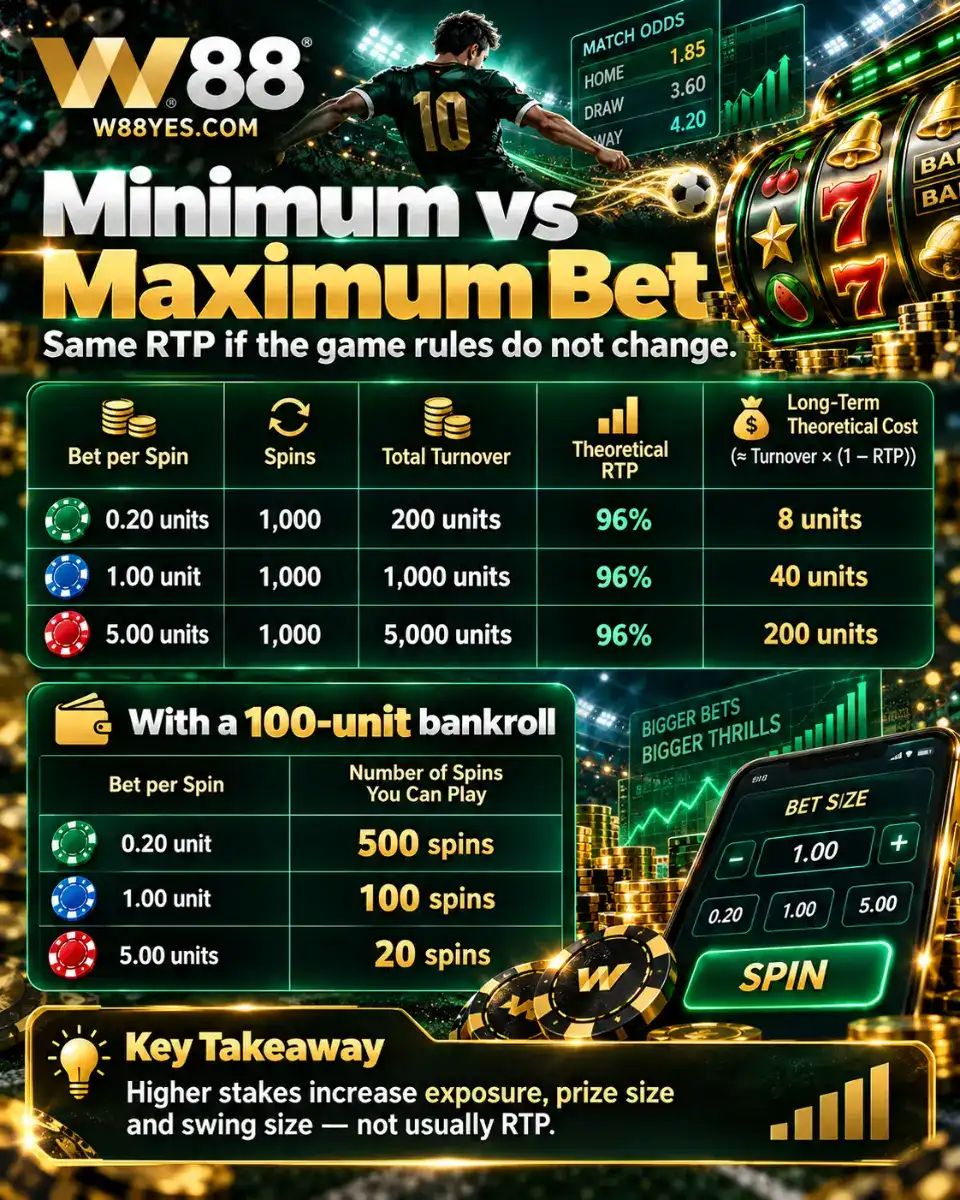
If both wager levels use the same game configuration, neither one has a hidden mathematical advantage. The following example uses a slot with a stated 96% RTP and identical features at every stake.
| Bet per Spin | Spins | Total Turnover | Theoretical RTP | Long-Term Theoretical Cost |
|---|---|---|---|---|
| 0.20 units | 1,000 | 200 units | 96% | 8 units |
| 1.00 unit | 1,000 | 1,000 units | 96% | 40 units |
| 5.00 units | 1,000 | 5,000 units | 96% | 200 units |
The percentage remains 96% in every row. The theoretical cost rises because the larger stake creates more turnover.
These figures are mathematical averages, not predictions for the next 1,000 spins. Volatility can produce results far above or below the theoretical figure during any realistic session.
What Really Changes When the Bet Increases
Even when RTP stays the same, moving from a minimum wager to a maximum wager changes several practical parts of the session.
The Cash Value of Every Multiplier
Slot prizes are often displayed as a multiple of the total bet. A 100x result is worth 20 units on a 0.20-unit spin and 500 units on a 5.00-unit spin.
The larger amount can look like a better game result, but the probability and multiplier may be unchanged. The player simply risked more money to receive the larger cash value.
The Speed of Bankroll Movement
A higher stake can reduce the number of spins a fixed balance can support.
With a balance of 100 units:
- A 0.20-unit wager provides 500 spins before any returns are considered.
- A 1.00-unit wager provides 100 spins.
- A 5.00-unit wager provides 20 spins.
Wins can extend the session, but they do not remove the difference in exposure. At the maximum bet, ordinary losing sequences consume the balance much faster.
The Size of Normal Swings
Volatility is normally described in multipliers, while the player experiences it in money. If two players use the same volatile game but one stakes 25 times more per spin, the second player experiences cash swings roughly 25 times larger for equivalent multiplier results.
The Cash Value of the Maximum Win
If a game advertises a maximum win of 5,000x the stake, the theoretical cash ceiling scales with the wager until an operator or game payout cap applies.
- 0.20 × 5,000 = 1,000 units
- 1.00 × 5,000 = 5,000 units
- 5.00 × 5,000 = 25,000 units
Reaching the advertised maximum remains extremely unlikely. A larger stake changes its cash value, not necessarily the probability of landing it.
When Bet Size Can Affect the Game
“Bet size does not change RTP” is a useful general rule, but it should not be treated as universal. The following features can make one wager structurally different from another.

Selectable Paylines or Ways
Some line-based slots allow the player to activate fewer paylines. A smaller total wager may therefore cover fewer winning patterns rather than placing a smaller amount across the same patterns.
Activating more lines can increase the chance of recording some type of win because more combinations are covered. It also increases the total cost of the spin. This does not automatically create a higher return percentage; the paytable and line rules determine the actual mathematics.
Always check whether the bet control changes the coin value, the number of coins per line, the number of active paylines or several settings together.
Jackpot Eligibility
Some fixed or progressive jackpots require an eligible wager. Depending on the game, eligibility may require the maximum bet, a separate jackpot contribution or a specified minimum stake.
Other games make the jackpot available at every wager and simply scale the prize or contribution with the stake. There is no universal rule. The jackpot panel or game information screen should state the qualifying conditions.
If a displayed RTP includes a jackpot contribution, the rules should also explain the wager conditions required to access that part of the theoretical return.
Ante Bet, Super Spin and Enhanced Bet Modes
An Ante Bet or enhanced spin normally costs more because it changes a feature probability or adds a guaranteed mechanic. For example, the mode may increase the chance of triggering free spins, add special symbols or guarantee a multiplier condition.
This is not the same as moving the ordinary stake slider from minimum to maximum. The player has selected a different wager mode with different rules. The information panel should be checked for its price, feature probability and RTP.
Bonus Buy
A Bonus Buy uses a larger one-time wager to enter a feature directly. It can have a separately stated RTP and a very different distribution of results from the base game.
Buying a bonus does not guarantee profit or make the game safe. It concentrates many normal spins’ worth of stake into one feature purchase and can produce a complete loss quickly.
Different Game or Operator Configurations
The same slot title may sometimes be available in more than one approved RTP configuration. One operator might offer a different version from another operator, even though the graphics and title look identical.
That difference comes from the active game configuration, not from an individual player choosing a higher standard stake. Check the RTP shown inside the specific game session instead of assuming that every copy of a title uses the same percentage.
Does Max Bet Improve the Chance of Winning?
Not automatically.
If all paylines, symbols and features remain active at every wager, Max Bet normally scales the prize and loss amounts without changing the probability of each result. A winning spin does not become more likely simply because more money was placed on it.
Max Bet can matter when the rules explicitly connect it to something else, such as:
- Activating every payline
- Qualifying for a particular jackpot
- Increasing coins per line in a paytable where the top award is not proportional
- Entering an enhanced feature mode
- Meeting the minimum stake for a promotion
Those are disclosed rule conditions. They are not evidence that an ordinary maximum wager makes the RNG more generous.
RTP, Hit Frequency and Volatility Are Different
Bet size is often blamed for changes that are actually caused by three different game measurements.
RTP
RTP describes the theoretical proportion of total turnover returned as prizes over the long term.
Hit Frequency
Hit frequency describes how often a spin produces a payout under the game’s definition of a hit. A high hit frequency does not guarantee profit because many prizes can be smaller than the stake.
Volatility
Volatility describes how the return is distributed. A lower-volatility game tends to produce smaller prizes more frequently, while a higher-volatility game may produce long losing periods interrupted by less frequent large results.
Two games can both have 96% RTP while feeling completely different. One may return many small amounts, while the other assigns more of its theoretical return to rare bonus rounds or large multipliers.
Increasing the stake makes the monetary swings larger. It does not convert a high-volatility slot into a low-volatility one.
How Stake Size Changes the Theoretical Cost
A simple way to compare wager levels is to calculate turnover and the theoretical house advantage.
Turnover = Bet per Spin × Number of Spins Theoretical Cost = Turnover × (1 − RTP)For a 96% RTP game, the theoretical house advantage is 4%.
If the stake is 0.50 units for 200 spins:
0.50 × 200 = 100 units of turnover 100 × 4% = 4 units of theoretical costIf the stake increases to 5.00 units for the same 200 spins:
5.00 × 200 = 1,000 units of turnover 1,000 × 4% = 40 units of theoretical costThe second session does not have a worse RTP. It produces ten times the turnover and therefore ten times the theoretical cost.
What to Check Before Changing the Bet
Before moving from the minimum wager to Max Bet, open the game’s information, rules or paytable and check:
- The stated theoretical RTP
- Whether all paylines or ways are active at the current wager
- Whether a jackpot has a minimum or maximum-bet requirement
- Whether the top prize scales proportionally with the stake
- Whether Ante Bet, Super Spin or similar modes have separate rules
- Whether Bonus Buy displays a different RTP
- The maximum win multiplier and any cash payout cap
- The total bet shown before confirming the spin
If the interface does not make the total stake clear, pause rather than assuming that the number represents a coin value, a line bet or the complete wager.
Common Myths About Slot Bet Size
“The Slot Notices Small Bets and Refuses to Pay”
In a properly operating RNG game, outcomes are not selected to punish an individual player for choosing the minimum wager. The cash prize is smaller because it is calculated from a smaller bet.
“Increasing the Bet After Losses Forces a Win”
Previous results do not make a future random result due. Increasing the stake after a losing sequence raises the amount at risk on the next spin without repairing earlier losses.
“Max Bet Always Has Better RTP”
Max Bet has a different RTP only when the paytable or feature rules create that difference. If the rules show the same configuration at every standard wager, the RTP normally remains unchanged.
“Minimum Bet Is Always the Safest Option”
A smaller stake reduces the amount exposed per spin, but it does not turn a negative-expectation game into a profitable one. Long sessions and rapid repeat play can still create substantial turnover at the minimum bet.
“A Bigger Cash Win Proves the Higher Bet Worked”
A larger bet multiplies the cash value of the same result. Compare wins in bet multiples—not only in currency—to understand whether the underlying outcome was actually different.
The Practical Answer
For most standard online slots, changing from the minimum bet to the maximum bet does not change RTP, hit frequency or RNG probabilities when the same paylines, paytable and features remain active.
What definitely changes is the amount of money moving through the game. Higher stakes create larger prizes when a win occurs, larger losses when it does not, faster turnover and a shorter margin for an unfavorable sequence.
The exceptions are visible in the rules: selectable paylines, jackpot qualification, enhanced bet modes, Bonus Buy options and non-proportional paytables. Treat each of these as a separate game condition and check the information screen before wagering.
The most useful rule to remember is:
Bet size controls financial exposure. Game rules determine whether it also changes the mathematics.
Play Responsibly
RTP is a long-term mathematical measure, not a prediction tool. Increasing the stake cannot recover previous losses or guarantee access to a profitable result. Set a fixed budget and time limit before playing, avoid chasing losses and use only money you can afford to lose. Players must meet the legal age requirement in their location.
Help Center & FAQ
Does betting more increase slot RTP?
Usually no. If the paytable, paylines and features remain the same, increasing the standard stake normally changes the cash value of prizes without changing the theoretical RTP.
Does Max Bet increase the chance of winning?
Not automatically. It may activate additional paylines or jackpot eligibility in certain games, but those conditions must be stated in the rules. On a game where every feature is active at all wagers, Max Bet normally does not improve the probability of a win.
Is the minimum bet lower RTP?
Not necessarily. Many online slots use the same theoretical RTP across all standard wager levels. Check the information screen for any bet-dependent paytable, line or feature rules.
Why do wins look more frequent after increasing the bet?
A short sequence can create that impression through normal randomness. Larger cash prizes are also more noticeable. Compare a large number of results in multipliers rather than currency, but remember that a personal session is not enough to verify theoretical RTP.
Can changing coin value affect RTP?
It can if coin value is tied to a different paytable, number of active lines or jackpot condition. If coin value only scales the same total wager structure, the RTP normally remains the same.
Do all paylines need to be active?
Some older or line-selectable games allow fewer paylines. Activating fewer lines means fewer winning patterns are covered. Modern slots often keep all lines or ways active and adjust only the stake per line, but the rules should always be checked.
Does a progressive jackpot require Max Bet?
Some do and some do not. The game may require Max Bet, a minimum eligible stake or a separate contribution. Other jackpots are available at every stake. The jackpot rules provide the final answer.
Does Bonus Buy have the same RTP as the base game?
Not always. Bonus Buy can be treated as a separate wager mode with its own cost, return distribution and stated RTP. Check the feature information before purchasing it.
Does a larger bet reduce slot volatility?
No. It increases the monetary size of the swings but does not normally change the game’s underlying volatility. A volatile result remains volatile at both small and large wagers.
Can a higher bet recover previous losses faster?
It can produce a larger cash return if a win occurs, but it also produces a larger loss if the next spin loses. Random outcomes do not become more favorable because the player is behind, so raising the stake to chase losses increases risk rather than creating a recovery advantage.